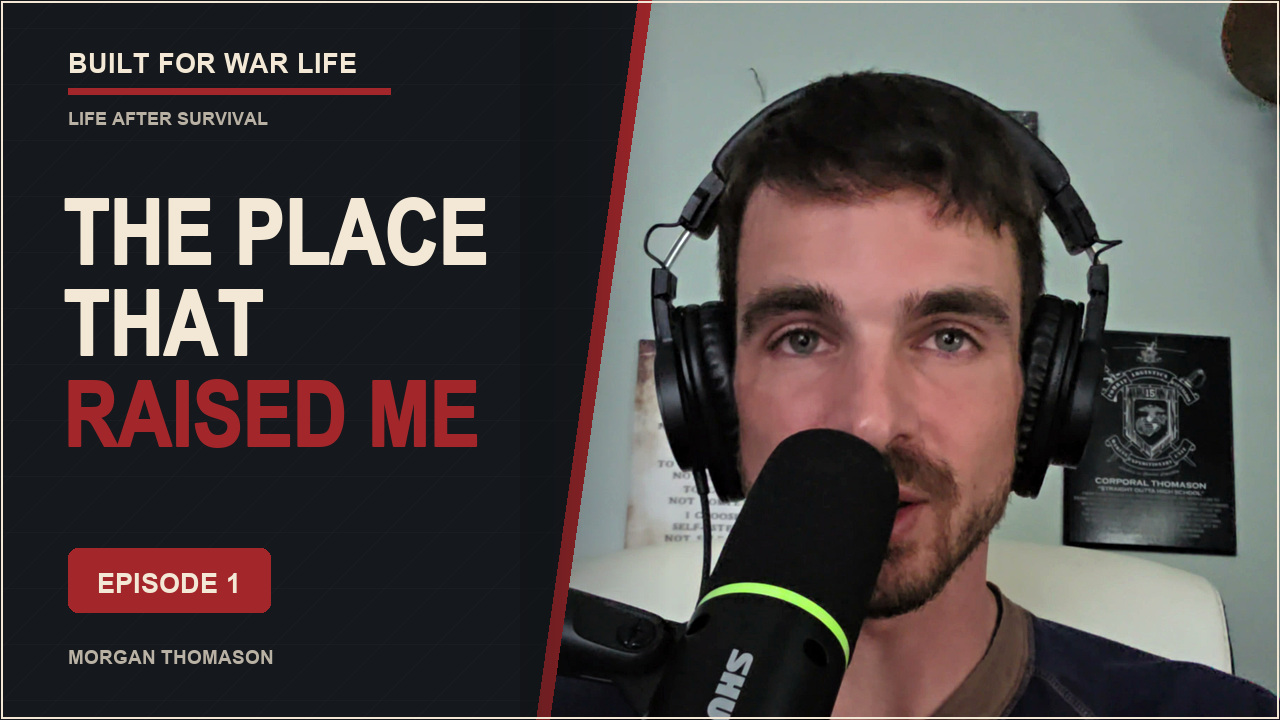
Season 1 · Episode 1 · 19:41
The Place
That Raised Me
Before the Marine Corps gave Morgan Thomason a uniform, life had already taught him to survive.
Content note: Discusses childhood poverty, housing instability, homelessness, and non-graphic references to drugs, alcohol, and gangs.
Episode overview
What survival gives us—and what it costs.
In the first full episode of Built For War Life: Life After Survival, Morgan looks back at unstable housing, a rare memory of sharing French vanilla ice cream with his father, the structure he found in football, the belonging he found in the streets, and the period when survival became literal.
He examines how alertness, loyalty, endurance, and adaptability can become strengths—and how those same instincts can follow a person long after the danger is gone.
What did the place that raised you teach you that you still need, and what are you finally ready to put down?
Chapters
Follow the story.
- 00:00Before the Uniform
- 00:30Why This Story Starts Earlier
- 02:09Home Was Never One Place
- 06:32The Field Gave Structure
- 08:25When the Streets Feel Like Belonging
- 11:42Survival Became Literal
- 14:04What Survival Gave Me
- 17:02What Survival Cost
- 17:55Learning to Live
- 18:30Fatherhood and the Choice Forward
Full edited transcript
Read Episode 1.
Timestamps follow the final 19:41 episode master.
Before the Marine Corps ever gave me a uniform, life had already trained me to survive.
I learned how to read a room, how to adapt, how not to need too much, and how to keep moving even when home did not feel permanent.
The place that raised me was not one address.
It was every room, street, field, and person that taught me what belonging could give you, but also what it could cost.
I'm Morgan Thomason, and this is Built For War Life, life after survival.
This show is about the forces that shape a survivor—poverty, instability, the streets, loyalty, the Marine Corps, leadership, loss, and fatherhood—
and the harder work of learning to live after the danger is gone.
When people hear that I'm a Marine, that is often where they begin my story.
They see the discipline, intensity, alertness, and the need to protect.
They assume the Corps created all of it, but it didn't.
The Corps gave it structure. It gave it standards, a purpose, and a mission.
But the raw material was already there.
I'm not telling the story to turn hardship into a badge or to make every person from my past a hero or a villain.
I'm telling it because where we learn to survive can keep shaping us long after we leave.
It's important because my foundation, the fundamentals, the beginning, starts before the Marine Corps.
I had to learn how to survive, how to adapt, how to be alert, how to read people, objects, situations,
in order to ensure that I was able to see the next day.
Because I knew that one mistake, one misread, could have some serious consequences.
The place was never one place. I was constantly moving.
For some people, home is a house they can picture from every angle.
They have a bedroom, a kitchen, and a front door they walk through year after year.
My memory of a home is more like a series of locations.
An attic, a living room, a car, a single-room motel, places around Triangle and the Quantico area,
Manassas, and moments when heat or running water could not be taken for granted because they weren't always there.
That kind of instability teaches a kid to scan.
What is safe here? How long can we stay here? What does everybody need from me?
What should I keep packed? What am I not supposed to ask for? What am I supposed to do under certain circumstances?
A child usually does not call that survival mode. He calls it normal because normal is whatever keeps happening.
A place that I continuously remember is an attic-like area where my mother, my brother, and I stayed.
It smelled horrible. The rugs were dirty. The carpet was dirty. There was mold. There were roaches everywhere.
Every drawer you opened had roaches. It was nasty. I felt embarrassed. I felt small.
I felt like this is not normal and I don't want to live like this. I don't want to be here.
I got there as late as possible and I left as early as possible because I didn't want to be there any longer than I had to.
There were also small things that carried more weight than they looked like they should.
Prior to the instability and chaos: a cup of French vanilla ice cream with one of those wooden spoons.
A football field. A bag that held what mattered because there was not always room for much else.
When life is unstable, ordinary things become anchors. You remember the taste, the texture, the walk, the sound of a door,
because those details made a moment feel solid—a solid moment prior to the chaos.
I remember sitting down and eating some French vanilla ice cream with the wooden spoon on the curb with my dad.
I don't have too many memories with my dad, but one of those is a special memory of me and him. We didn't talk.
He wasn't a man of many words, but it was the action of us just being together, just kicking it, hanging out.
And it meant a lot to me at the time and now. It's something that has always stuck with me.
It was a good memory. It was warmth. Even though the ice cream was cold.
It was a closeness to someone that I wanted to be close to, but not always having the ability to be close to them or the know-how to be close to them.
Instability made me adaptable. That is a strength, but it also trained me not to settle too deeply, not to assume anything would last,
and not to expect someone else to make things secure. School and football gave me something different.
The field had lines, practice had a time, effort had a consequence. A team gave me a role.
When the rest of life feels unpredictable, structure can feel like mercy. You know where to stand. You know what is expected.
You know that if you keep moving, somebody may notice the work.
Football also gave intensity somewhere useful to go. The same energy that could become anger, fear or trouble was given a direction.
It became repetition, effort, contact and responsibility to the people beside me.
I remember going to football practice and knowing that if I didn't do my job, that I would be letting the person to my left and to my right down.
I know I would be failing the team. I know that it could cost the team a win.
It could be a failure and it could have consequences of how they looked at me, responded to me, and how I responded to them.
And that lesson mattered later on.
Long before I understood leadership, I was learning that discipline can turn raw survival energy into something that serves a group.
When the streets feel like belonging, that's how they feel. The streets were not only danger to me, that is the part people often miss.
There were risks around me. Yeah, there were drugs and alcohol and gangs and bad choices and consequences. I would not pretend otherwise.
But there was also acceptance. There were people who made me feel like I was home.
They made room for me when I did not always feel that room existed anywhere else. They gave me that.
They gave me that. Belonging is powerful. When you have been moving through life feeling temporary, being recognized, protected, and having people expect your loyalty can feel like home.
That does not make every choice right. It explains why the choice could feel right to the person making it at the time, but it doesn't make it right.
I felt safe when I was in the streets. I didn't have to worry about, you know, I actually had to worry about a lot, but I knew I didn't have to worry about it alone.
That's how we made each other stronger. That's how we constantly adapted and continued to grow in an environment that not many things were able to grow.
But survival, it changes someone. It forces someone to get left behind or soar. And it's important to understand that thriving in the streets leads to multiple different things.
And not all of them are good, but there are some. The same place can give you community and teach you to keep your guard up.
The same loyalty that keeps you from feeling alone can make it hard to question what the group expects.
The same alertness that protects you on one street can follow you into every room after you leave it.
And that's something that you have to understand, that when you are built under pressure and you stay quiet and you have to constantly prove yourself and your strength, not just mentally but physically, it continues.
It doesn't leave. It follows you everywhere you go up until this day right now. It's still within. And it's not going anywhere.
But it's up to me to choose how to utilize it in a manner that is productive and positive and not allow it to try and control me or control the situation that I'm in.
Because those are my actions and my responsibilities. It is up to me. But it's different when you're younger. Around my mid-teens, survival became more literal.
There were times I had to think about where I could sleep, how long I could stay there, how to move without becoming a problem for anybody.
Because I didn't have a home. It wasn't a set place. I was on my own without anyone or any help. I had to learn routines to help make me feel like the next day was going to be there.
I also learned how easy it is to become proud of not needing help when needing help feels dangerous or humiliating.
It's important to understand that when you're faced with decisions that can humiliate you, you're given a choice to either adapt and overcome that situation, that feeling and move forward or to allow it to consume you.
And that's something that a lot of people kind of overlook is that it's not all physical, but it's mental. A lot of it is.
So say around 15 or 16, I was homeless. There was not a physical environment and I had to continue to push.
And in the streets, that's where I found that acceptance. I found my family. I found individuals that cared for me.
Sometimes more than I felt like my own family cared for me. I knew that these people would give their all, give their last for me, give the shirt off their back for me.
And I would do the same. Up until this day, I will still give them the shirt off my back because I love them. I know they love me.
Even though there's distance, I know we're still family. And that's never going to change. But survival taught me to adapt fast.
It taught me to watch the room, protect the people I considered mine, take responsibility early, and keep working when comfort was not available.
And a lot of times, comfort was just not available. Those traits later had value. They helped me function under pressure. They helped me understand loyalty. They gave me a high tolerance for hard days.
The Marine Corps did not have to create the endurance. Life had already done much of the training for me already. But every survival skill has a context.
A response can be intelligent in danger and destructive in peace. And you have to be able to know the difference if you want to be able to survive.
Because you can act one way in one scenario in the same way in another and have two completely different outcomes.
I had to be able to be alert of who was around, how I was going to act when those individuals were around, or what the situation needed of me in order for me to get through it.
I knew I had my family behind me.
And I was there for them. And we had that bond. We were—we are—that family. But that doesn't mean that I'm going to make the same choices as them because I'm not. I didn't.
And I learned from those around me, what choices to make, what choices not to make, and how to overcome a lot of different circumstances.
Those traits later had value. They helped me function. And that's what really people need to understand is that the foundation that built me was the streets.
I was built for war long before I ever joined the Marine Corps. I do not want to erase those strengths. I want to decide when they serve the life I'm building now, and when they are still obeying a danger that is no longer in front of me.
It's up to me to decide when things are changing, how they're changing, and how to adapt to those things.
And even though those strengths have served me well in the past, under certain conditions, they also have costs that come with them.
The cost is that peace can feel unfamiliar. Rest can feel irresponsible. Help can feel like exposure.
Consistency can be hard to trust because part of you is waiting for the conditions to change, as they often did before.
You can become very good at providing and protecting while still struggling to be present.
You can love people deeply and still carry the belief that your value comes from what you can endure for them.
And that's the difference between surviving and living. Survival asks, how do I get through this? Living asks, what am I building with the strength it gave me?
Life after survival does not require me to hate the place that raised me. It requires me to tell the truth about it.
I can honor the people who gave me belonging without glorifying the danger. I can value the strength I developed without letting struggle remain the only place where I know who I am.
Fatherhood has made that question much sharper for me. Protection still matters. Providing still matters, but my children also need presence. They need patience, honesty, and a father who can recognize safety when it's there.
So here's the question I am carrying this week. What did the place that raised me teach me that I still need? And what did it teach me that I'm finally ready to put down?
Where I came from is part of me. It does not get to make every decision for the man I am becoming.
If the story gave words to something you have carried, follow or subscribe to Built For War Life. The next episode will go deeper into one of the physical memories of poverty, the purple bucket, and what dignity looks like when basic things are not guaranteed.
I'm Morgan Thomason. This is Built For War Life, life after survival.